Growth is exciting. New leads start coming in, conversations increase, and opportunities seem to pop up everywhere. But for many growing businesses, this excitement quickly turns into confusion. Deals slip through the cracks. Follow-ups are missed. Teams are unsure which leads matter most.
This is exactly why sales pipeline management becomes the first priority for businesses that are serious about scaling. Before fancy strategies or aggressive expansion plans, companies need clarity. They need to see what is happening in their sales process, stage by stage, deal by deal.
Let’s break down why managing the sales pipeline comes first—and why skipping it can quietly stall growth.
Growth Without Structure Creates Chaos
In the early days, sales are simple. A few leads, a few calls, and deals are tracked mentally or in spreadsheets. But once a business starts growing, this approach stops working.
Leads increase. Sales conversations happen across emails, calls, chats, and meetings. Without a clear pipeline, it becomes impossible to answer basic questions like:
- Which deals are close to closing?
- Which leads need follow-ups?
- Where are deals getting stuck?
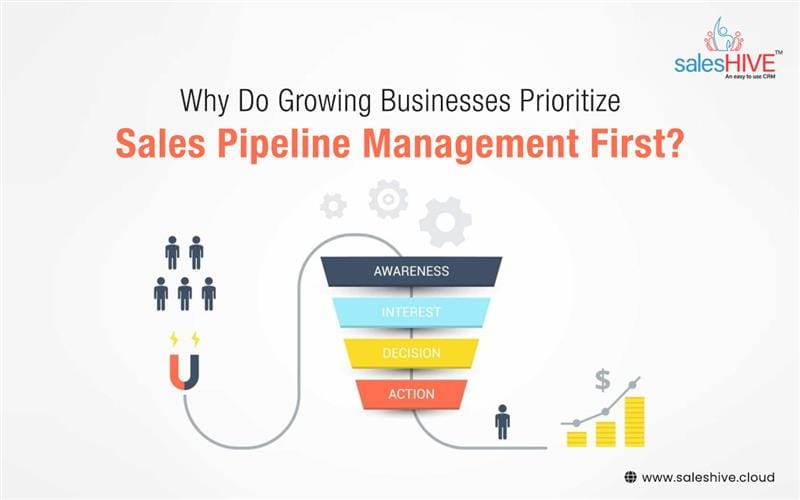
This is where sales pipeline management steps in. It creates a structured flow that shows every opportunity from first contact to final conversion. Instead of guessing, teams can see exactly where they stand.
Visibility Drives Better Decisions
One major reason growing businesses prioritize pipeline management is visibility. When every deal is mapped to a stage, decision-making becomes easier and faster.
Sales leaders can instantly spot:
- Bottlenecks in the sales process
- Stages where leads drop off
- Top-performing team members
- Realistic revenue forecasts
This level of clarity is nearly impossible without proper tools. That’s why many growing teams turn to sales crm software to centralize data and maintain consistency across the sales cycle.
When everyone works from the same system, confusion disappears—and performance improves.
Time Becomes More Valuable Than Ever
As businesses grow, time becomes their most limited resource. Manually updating spreadsheets, searching old emails, or remembering follow-ups wastes hours every week.
This is why sales automation tools play such an important role alongside pipeline management. Automation handles repetitive tasks like:
- Sending follow-up reminders
- Updating deal stages
- Logging customer interactions
- Assigning leads to the right team members
Instead of chasing admin work, sales teams can focus on conversations that actually close deals. That shift alone can dramatically increase productivity without adding more people.
A Managed Pipeline Improves Conversion Rates
More leads don’t automatically mean more sales. In fact, unorganized growth often lowers conversion rates because good leads get ignored.
With strong sales pipeline management, every lead is treated with intention. Each stage has a purpose. Each action moves the deal forward.
Sales teams know:
- What to say at each stage
- When to follow up
- Which objections are common
- When a deal is ready to close
This structured approach builds consistency, and consistency builds trust—both internally and with customers.
Scaling Requires Predictable Revenue
Growing businesses don’t just want sales; they want predictable sales. Investors, partners, and leadership teams rely on accurate forecasts to plan hiring, marketing, and expansion.
A well-managed pipeline makes forecasting realistic rather than hopeful. Since every deal is tracked, revenue predictions are based on real data, not assumptions.
This is where a cloud based crm becomes especially valuable. Cloud systems allow teams to access real-time pipeline data from anywhere, ensuring forecasts stay updated as deals move forward.
Predictability turns growth from risky to strategic.
Alignment Between Sales and Marketing Improves
Sales and marketing misalignment is a common growth problem. Marketing brings leads, sales complain about quality, and nobody agrees on what “qualified” means.
Pipeline management solves this by defining clear stages and criteria. Marketing knows what type of leads actually convert. Sales receive better-prepared prospects. Feedback flows both ways.
When paired with sales crm software, both teams can see the same lead journey—from first interaction to closed deal. This alignment reduces friction and improves overall performance.
New Team Members Ramp Up Faster
Growing businesses often hire quickly. New sales hires need guidance, structure, and clarity. Without a defined pipeline, onboarding becomes slow and inconsistent.
A structured sales pipeline acts like a roadmap. New team members immediately understand:
- How the sales process works
- What actions are expected at each stage
- How success is measured
With the help of sales automation tools, new hires can start contributing faster, without feeling overwhelmed.
Customer Experience Improves Naturally
Customers notice when a sales process feels smooth. They feel remembered, not chased. They receive timely responses instead of random calls.
Pipeline management ensures no lead is forgotten and no deal is rushed. Combined with a cloud based crm, every interaction is logged, creating continuity even if team members change.
A better customer experience doesn’t require extra effort—it happens naturally when the sales process is organized.
It Builds a Foundation for Long-Term Growth
Many businesses chase growth tactics before fixing internal systems. This often leads to burnout, lost revenue, and stalled momentum.
By prioritizing sales pipeline management early, growing businesses build a strong foundation. Once the pipeline is stable, scaling becomes smoother. Marketing campaigns perform better. Sales teams stay focused. Leadership makes confident decisions.
Growth stops being chaotic and starts becoming repeatable.
Growing businesses prioritize sales pipeline management first because it brings clarity, control, and confidence. It turns scattered efforts into a structured process, saves time through automation, improves conversions, and creates predictable revenue.
When supported by the right sales crm software, sales automation tools, and a reliable cloud based crm, the sales pipeline becomes more than a tracking system—it becomes the engine that drives sustainable growth.
Before scaling faster, smart businesses choose to scale smarter. And it always starts with managing the sales pipeline