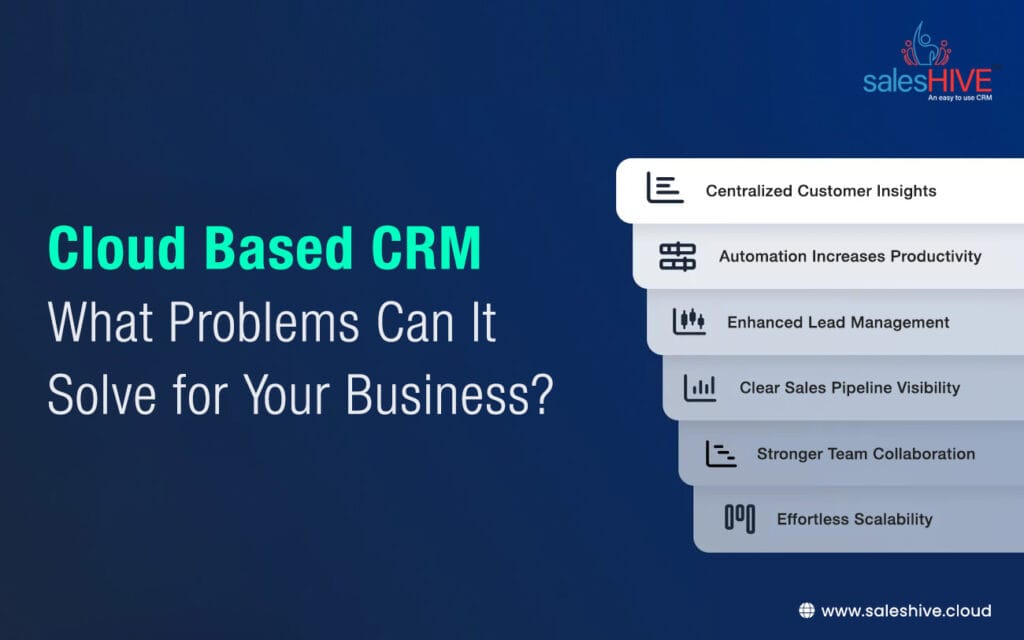
In today’s fast-paced digital world, every business—big or small—is searching for a smarter way to manage customer relationships, track sales, and keep teams aligned. That’s exactly where a cloud based CRM steps in and transforms the way businesses operate. Gone are the days of messy spreadsheets, scattered client notes, and missed follow-ups. Modern CRM solutions allow businesses to streamline processes, understand customer behavior better, and ultimately drive more revenue with less effort.
But the real question is: what problems can a cloud based CRM actually solve for your business? If you’ve ever struggled with sales organization, communication gaps, or inefficient workflows, this blog will open your eyes to the true power of a well-implemented CRM.
1. Disorganized Customer Data and Scattered Information
One of the biggest frustrations for teams is having customer data spread across multiple tools, inboxes, and spreadsheets. When information is scattered, you lose valuable time searching for details and risk making poor decisions based on incomplete data.
A cloud based CRM centralizes everything in one place, giving your team instant access to:
- Contact information
- Communication history
- Purchase records
- Lead details
- Notes and follow-ups
This ensures everyone stays on the same page, no matter where they’re working from.
2. Poor Sales Tracking and Unclear Performance Metrics
Many businesses struggle to understand where leads are coming from, which deals are in progress, and why certain opportunities are slipping away. Without a proper system in place, it becomes nearly impossible to measure performance accurately.
That’s where sales pipeline management becomes a game-changer.
With a CRM, you can:
- Visualize every stage of your pipeline
- Track which leads are close to converting
- Identify bottlenecks
- Prioritize high-value opportunities
- Forecast revenue with more accuracy
Instead of relying on guesswork, your sales team gets a clear, structured path to follow—leading to better decision-making and improved efficiency.
3. Lost Leads and Missed Follow-Ups
Let’s be honest… follow-ups make or break sales. But when your team manages leads manually, it’s incredibly easy to forget important calls, emails, or meetings. Every missed follow-up means losing potential revenue.
A cloud based CRM solves this problem by automating reminders and notifications so no opportunity slips through the cracks. Whether it’s:
- Sending a follow-up email
- Scheduling a call
- Tracking the customer journey
- Notifying you when a lead revisits your website
The CRM keeps your team on track with timely alerts. This alone can increase conversions dramatically.
4. Inefficient Collaboration Between Teams
When marketing, sales, and support teams use different tools, communication becomes chaotic. Messages get lost, tasks are duplicated, and customer experience suffers.
A CRM unifies these functions, allowing teams to work together seamlessly. Everyone gains access to updated information, enabling:
- Better cross-team collaboration
- Faster issue resolution
- Clear visibility into customer needs
- A smoother onboarding or support process
This ensures your customers enjoy a consistent and professional experience at every touchpoint.
5. Limited Accessibility and Remote Work Challenges
Traditional software requires installation on local devices, and accessing data outside the office can be complicated. But with a cloud based CRM, your team can work from anywhere—home, office, or on the road.
All you need is an internet connection.
This flexibility is especially beneficial for:
- Remote teams
- Field sales representatives
- Freelancers or contractors
- Businesses with multiple office locations
With real-time data available 24/7, decision-making becomes faster and more accurate.
6. Inaccurate Forecasting and Slow Decision-Making
Business leaders need accurate insights to make smart decisions, especially when it comes to sales growth and customer acquisition. But without proper analytics, forecasting becomes nothing more than guesswork.
A CRM provides powerful reporting features such as:
- Sales performance dashboards
- Pipeline progress reports
- Lead conversion analytics
- Customer behavior insights
- Revenue forecasting
These insights help you spot trends early, allocate resources better, and adjust strategy based on real data—not intuition.
7. Manual Sales Processes That Slow Growth
Repetitive tasks like sending emails, updating lead status, assigning tasks, or logging activities can consume a huge chunk of your sales team’s time. This reduces productivity and delays conversions.
Modern sales CRM software automates many of these tasks, allowing your team to focus on what they do best—closing deals.
Some tasks you can automate include:
- Email sequences
- Lead scoring
- Task assignment
- Follow-up reminders
- Customer onboarding workflows
This not only saves time but also ensures consistency across your entire sales process.
8. Difficulty Scaling as Your Business Grows
As your customer base expands, manual processes simply can’t keep up. You risk losing track of leads, confusing client histories, and overwhelming your team.
A CRM grows with you—offering more advanced features as your business needs evolve. Whether you’re scaling your sales team or expanding into new markets, the CRM supports this growth without breaking your existing workflow.
A cloud based CRM is more than just a tool—it’s a complete solution for managing your sales workflow, improving customer relationships, and driving long-term business success. From sales pipeline management to daily communication and automation, a CRM eliminates inefficiency and brings clarity to your operations. It helps your team stay organized, improves collaboration, enhances customer experiences, and provides the insights you need to make smarter decisions.If your business is struggling with lost leads, messy data, or inconsistent sales processes, integrating reliable sales CRM software could be the transformation you need. By centralizing information, improving accuracy, and enhancing productivity, a CRM sets the foundation for predictable growth and stronger customer loyalty.
FAQs
1. What is a Cloud Based CRM?
A Cloud Based CRM is an online customer relationship management system that helps businesses manage leads, customer interactions, sales pipelines, and business data from anywhere using an internet connection.
2. What business problems can a Cloud Based CRM solve?
A Cloud Based CRM solves common business challenges such as missed follow-ups, scattered customer data, poor team collaboration, inefficient lead management, and inaccurate sales tracking.
3. How does SalesHive Cloud Based CRM improve lead management?
SalesHive CRM captures leads from multiple sources, assigns them to the right team members, tracks every interaction, and ensures timely follow-ups to improve conversion rates.
4. Can a Cloud Based CRM improve team collaboration?
Yes. SalesHive CRM stores all customer information in one centralized platform, allowing sales, marketing, and management teams to collaborate in real time with role-based access.
5. Does SalesHive CRM automate sales tasks?
Yes. SalesHive CRM automates reminders, follow-up tasks, lead assignments, and workflow activities, helping businesses reduce manual work and increase productivity.
6. Is a Cloud Based CRM suitable for small businesses?
Absolutely. SalesHive CRM is designed for startups, SMEs, and growing businesses that need an affordable, secure, and scalable cloud-based solution to manage customer relationships efficiently.
7. Can I access SalesHive CRM from anywhere?
Yes. Because SalesHive is a cloud-based CRM, users can securely access customer records, sales pipelines, reports, and tasks from desktops, laptops, tablets, and mobile devices with an internet connection.
8. Why should businesses choose SalesHive Cloud Based CRM?
SalesHive CRM offers centralized customer management, automated workflows, real-time reporting, customizable sales pipelines, and secure cloud access, helping businesses improve efficiency, customer satisfaction, and overall sales performance.