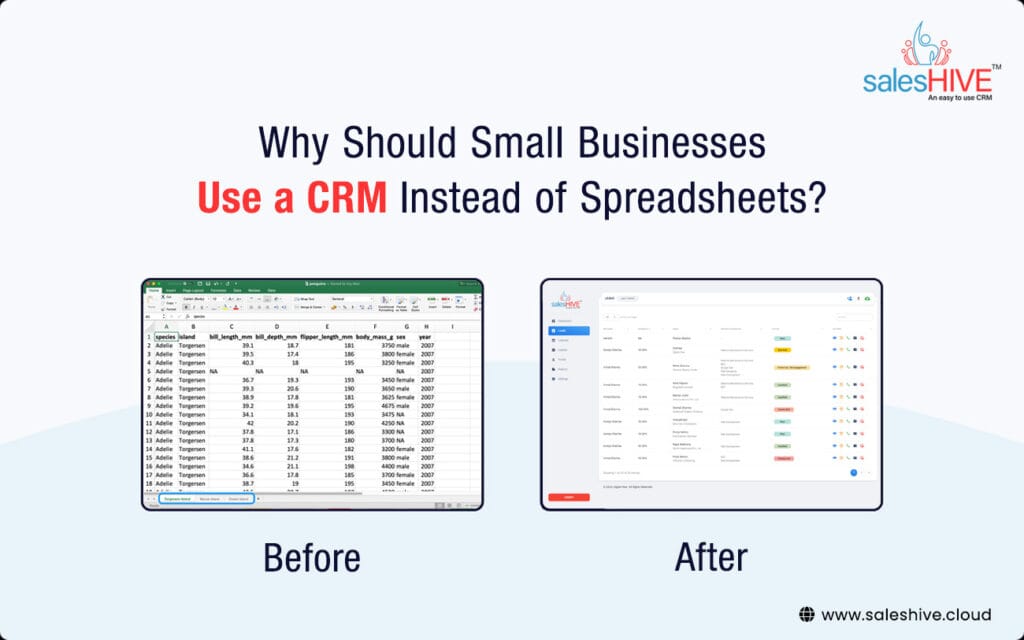
Running a small business means juggling multiple things at once — managing leads, following up with clients, tracking sales, and trying to stay organized. For many business owners, spreadsheets often become the default tool to keep everything in check. They’re easy, familiar, and free. But here’s the truth — as your business grows, those simple spreadsheets quickly turn into a messy maze of data, missed follow-ups, and lost opportunities.
That’s where a small business CRM (Customer Relationship Management system) steps in — not as another tool, but as a complete game-changer. Let’s break down why replacing spreadsheets with a sales CRM could be the smartest move your small business makes this year.
1. Spreadsheets Don’t Scale — CRMs Do
Spreadsheets might work fine when you have just a handful of customers. But as your client list grows, data becomes scattered across tabs, files, and team members. You spend more time finding information than actually using it.
A CRM for small businesses is built to grow with you. It stores customer information, tracks every interaction, and organizes data in one central place. Whether your sales team expands or your lead volume doubles, a sales CRM keeps everything structured, searchable, and scalable.
No more endless scrolling or lost entries — just clean, real-time data that works as fast as your business does.
2. Automation Saves Time and Reduces Errors
Manual data entry in spreadsheets is not just time-consuming; it’s error-prone. A single typo or misplaced formula can throw off your entire sales report.
A small business CRM automates repetitive tasks like data entry, lead assignment, and follow-up reminders. It captures contact details directly from forms, emails, or social media and updates records automatically. That means your team spends less time fixing mistakes and more time building relationships.
Automation = Accuracy + Efficiency.
And when you’re running a small business, those two things matter more than anything else.
3. Better Lead Management and Follow-Ups
How many potential customers slip through the cracks because you forgot to follow up? With spreadsheets, it’s easy to lose track of where a lead stands in your pipeline.
A sales CRM eliminates that chaos. It visually tracks every lead’s journey — from the first inquiry to the final sale. You can set follow-up reminders, add notes, and see which stage each customer is in. This ensures no opportunity is missed and every lead is nurtured effectively.
A CRM doesn’t just manage contacts — it manages conversations.
4. Real-Time Insights for Smarter Decisions
Spreadsheets give you data. A CRM gives you insights.
With a small business CRM, you can track performance metrics like conversion rates, revenue trends, and customer engagement in real time. You’ll know which campaigns are working, which sales reps are closing more deals, and where improvements are needed.
Instead of making guesses based on static data, you make decisions backed by real-time analytics.
Insight-driven decisions are what turn a small business into a scalable brand.
5. Improved Team Collaboration
If your team is sharing spreadsheets via email or cloud drives, you know the struggle — version mismatches, duplicate edits, and confusion over who updated what.
A CRM system fixes all that. Every team member has access to the same centralized dashboard. Notes, updates, and client interactions are logged instantly, so everyone stays aligned.
Whether your sales, marketing, or support teams are working remotely or in-office, a CRM ensures everyone is on the same page — literally.
6. Enhanced Customer Experience
Today’s customers expect personalization. They don’t want to feel like just another name in your spreadsheet.
With a small business CRM, you can personalize every interaction. The system keeps track of customer preferences, purchase history, and communication records. This allows you to send tailored messages, anticipate needs, and build stronger relationships.
When customers feel understood and valued, loyalty follows naturally.
And that’s something no spreadsheet can deliver.
7. Centralized Data Means Less Chaos
Think of a CRM as your business’s memory bank. Instead of customer details scattered across emails, WhatsApp messages, and Excel sheets, everything lives in one organized place.
This centralized access means you can find client details instantly, check communication history, and even forecast future sales — all without digging through dozens of files.
In short, a sales CRM turns chaos into clarity.
8. Mobile Access Keeps You Connected Anywhere
Running a small business doesn’t mean sitting at a desk all day. You’re meeting clients, visiting suppliers, or networking. A CRM keeps you connected wherever you are.
With mobile access, you can update deals, check tasks, or respond to leads on the go. Spreadsheets? Not so much.
A CRM moves with you — your business in your pocket.
9. Streamlined Sales Pipeline
A sales CRM gives you a complete visual of your sales funnel. You can see exactly where each lead stands — whether they’re interested, negotiating, or ready to close.
This clarity helps you prioritize your efforts, identify bottlenecks, and close deals faster. Spreadsheets can’t give you that kind of visibility or flow.
A CRM transforms your sales process from guesswork into a guided journey.
10. Data Security and Backup
Spreadsheets can be easily deleted, misplaced, or shared with the wrong people. A CRM ensures your customer data is secure, backed up, and accessible only to authorized team members.
That’s not just smart — it’s professional. Protecting your clients’ information builds trust, which directly impacts your brand’s credibility.
11. Future-Proofing Your Business
Technology and customer expectations evolve constantly. A CRM system keeps you ahead of the curve by integrating with email marketing, social media, and automation tools. It adapts as your business grows — something spreadsheets simply can’t do.
By investing in a small business CRM, you’re not just organizing your sales today — you’re setting your foundation for long-term success.
Spreadsheets are great for quick lists. But when it comes to managing relationships, tracking leads, and driving sales, they fall short. A small business CRM is more than a tool — it’s your growth partner. It helps you stay organized, automate tasks, and understand your customers like never before.
If you’re still relying on spreadsheets, it’s time to upgrade.
A sales CRM brings order to chaos, clarity to data, and strategy to sales.
Because in business, success isn’t about working harder — it’s about working smarter.
Make the shift. Your future customers will thank you for it.
Also Read: Why Good CRM Software for Small Business Improves Customer Retention
FAQs
1. Why should small businesses use a CRM instead of spreadsheets?
A CRM centralizes customer data, automates follow-ups, tracks sales activities, and reduces manual errors. Unlike spreadsheets, it helps businesses scale efficiently while improving productivity.
2. What are the limitations of using spreadsheets for customer management?
Spreadsheets become difficult to manage as your business grows. They lack automation, real-time collaboration, lead tracking, reminders, and detailed reporting, which can result in missed sales opportunities.
3. How does SalesHive CRM improve lead management?
SalesHive CRM captures leads from multiple sources, assigns them to team members, tracks every interaction, and manages each opportunity through customizable sales pipelines.
4. Can SalesHive CRM automate follow-ups and reminders?
Yes. SalesHive CRM automatically schedules reminders, assigns tasks, and sends notifications so your team never misses an important follow-up or sales opportunity.
5. How does a CRM improve team collaboration?
A CRM provides a centralized database where every team member can access updated customer information, communication history, and sales activities, improving coordination and productivity.
6. Does SalesHive CRM provide reports and analytics?
Yes. SalesHive CRM offers real-time dashboards, sales pipeline reports, conversion tracking, and performance analytics that help businesses make informed decisions and improve sales performance.
7. Is SalesHive CRM suitable for startups and small businesses?
Absolutely. SalesHive CRM is designed specifically for startups and SMEs, offering an affordable, cloud-based, and easy-to-use CRM that grows alongside your business.
8. How does switching from spreadsheets to SalesHive CRM help businesses grow?
By replacing spreadsheets with SalesHive CRM, businesses gain automated workflows, centralized customer management, better collaboration, real-time insights, and a scalable sales process that supports long-term growth.